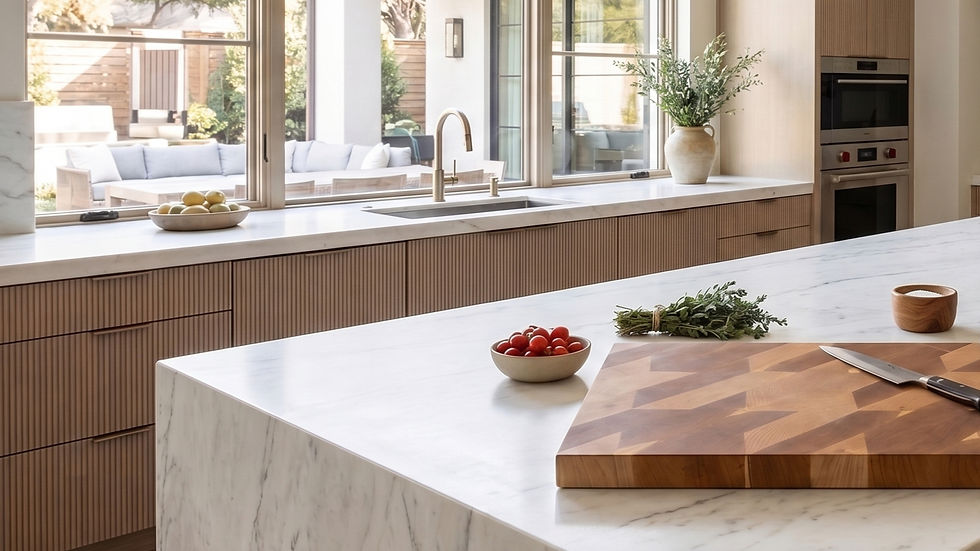
Microplastics vs. Microbial Defense: Why End-Grain Hardwood is the Only Choice for Biophilic Kitchen Hygiene

Hardwood end-grain surfaces function as a sophisticated biological filter, utilizing hygroscopic capillary action to draw pathogens into a terminal cellular matrix where they undergo rapid desiccation and neutralization. Unlike synthetic polymers, which suffer from irreversible scarring and shed up to 50.7 grams of microplastics into the food supply annually, luxury hardwoods represent a biophilic necessity that integrates intrinsic antimicrobial enzymes with generational durability. For the discerning Dallas homeowner, an investment in heirloom-quality hardwood is a commitment to the stewardship of family health and the preservation of culinary integrity.
Why Biophilic Kitchen Hygiene is the Biological Imperative for 2026
In the rarefied atmosphere of North Texas homes, from the estates of Highland Park to the modern sanctuaries of Preston Hollow, the tools of the kitchen are undergoing a fundamental shift from utility to legacy. For the discerning homeowner, the choice of a cutting surface is no longer a transactional purchase but a commitment to biophilic kitchen hygiene: the integration of natural materials to actively improve the home's biological ecosystem. While synthetic polymers are increasingly viewed as an architectural and biological incongruity, the end-grain hardwood board stands as an anisotropic cathedral of material science.
As the Founder and Craftsman at Key Home Goods, I have spent over six years specializing in the cellular mechanics of Sugar Maple, Black Cherry, and Black Walnut. My work focuses on how the vertical fiber orientation of an end-grain cutting board functions as a sophisticated biological filter. By leveraging the natural physics of hygroscopic capillary action, these boards don't just provide a surface—they trigger a powerful microbial defense mechanism that protects the culinary integrity of your family’s sanctuary.
The rate of this fluid draw and the subsequent neutralization of pathogens can be modeled through Jurin’s Law, which demonstrates why the microscopic radius (r) of vessel elements in closed-grain hardwoods is essential for high-performance hygiene:

In an era where synthetic boards contribute up to 50.7 grams of microplastics to the food supply annually, choosing a handcrafted hardwood surface is an act of biophilic stewardship. It is the definitive choice for those who view their kitchen not just as a place for preparation, but as a high-performance environment dedicated to wellness and excellence.
The Anisotropic Cathedral: The Cellular Mechanics of Hardwood
To appreciate the superiority of hardwood, one must delve into its complex micro-anatomy. Hardwoods are distinguished from softwoods by their intricate 3D hydraulic networks, which are composed of specialized cells: vessel elements, tracheids, and fibers. This structure is fundamentally anisotropic, meaning its physical and mechanical properties vary significantly based on the direction of the grain. In an end-grain board, the wood is cut perpendicular to these cellular "straws," exposing the longitudinal axis. The strongest and most conductive direction of the wood.
The Hydraulic Network: Vessels and Tracheids
Vessel elements are the primary conduits for water transport in the living tree, forming long tubular structures that, in a finished board, act as microscopic vacuum chambers. In diffuse-porous species like Sugar Maple (Acer saccharum), these vessels are distributed uniformly throughout the growth ring, providing a consistent surface density and a predictable response to humidity. Tracheids, while also participating in fluid conduction, provide the structural rigidity and mechanical reinforcement required to withstand the tension of water columns.
Anatomical Feature | Biological Function | Contribution to Microbial Defense |
Vessel Elements | Axial fluid transport | Rapid capillary draw of surface moisture and bacteria |
Tracheids | Support and conduction | Entrapment of microbes in narrowed cell cavities |
Pit Membranes | Inter-cellular filtration | Prevents the lateral migration of bacteria through cell walls |
Lignin | Rigid biopolymer | Resists enzymatic degradation by bacteria and fungi |
The presence of pits, small openings in the cell walls, allows for lateral movement of fluids while acting as secondary filters. In the heartwood of mature trees, many of these pits become aspirated or closed, which increases the wood's resistance to decay and prevents bacteria from penetrating deep enough to cause structural damage. This creates a paradoxical environment: the wood surface is porous enough to drink bacteria away from the food-contact area, yet dense enough to encapsulate them in a terminal matrix.
The Physics of Purification: Hygroscopicity and Capillary Action
The self-sanitizing power of hardwood is driven by its inherent hygroscopicity. The ability to exchange moisture with the surrounding air to reach a state of equilibrium. When a contaminated fluid, such as meat juice containing Salmonella or Listeria, is introduced to an end-grain surface, the wood’s thirsty cellular matrix triggers a powerful physical mechanism known as capillary action.
Mathematical Modeling of the Capillary Draw
The rate and height of this fluid draw can be described by the Jurin's Law equation, which calculates the height of capillary rise (h):
In this formula, gamma represents the liquid-air surface tension, theta is the contact angle of the fluid on the wood cell wall, rho (p) is the density of the liquid, g is the acceleration due to gravity, and r is the radius of the vessel element. In closed-grain hardwoods like Maple and Cherry, the radius is extremely small, which exponentially increases the capillary pressure. This ensures that even microscopic volumes of fluid are pulled deep into the wood's interior, effectively cleansing the surface within minutes.
Once the bacteria are trapped within the vessel elements, they are subjected to rapid desiccation. As the surface of the board dries, the moisture within the cells is either drawn further into the core or evaporates through the wood’s natural respiration process. Deprived of the hydration necessary for cellular respiration and reproduction, the bacterial population crashes, often reaching clean levels within three hours, even without the use of chemical disinfectants.
The Biochemical Shield: Tannins and Extractives
Hardwood defense is not merely a matter of physics; it is a sophisticated chemical engagement. Many premium wood species utilized in luxury board construction are rich in extractives. Secondary metabolites such as tannins, resins, and polyphenols that are inherently hostile to microbial life.
The Efficacy of Diffuse-Porous Species
Species such as Black Cherry (Prunus serotina) and Walnut (Juglans nigra) possess a chemical arsenal that actively degrades bacterial cell walls. Research utilizing gas chromatography-mass spectrometry (GC/MS) has identified dozens of unique extractives in these woods, many of which have confirmed antifungal and antibacterial properties.
Wood Species | Key Antimicrobial Compounds | Identified Biological Impact |
Sugar Maple | Phenolic enzymes, specific stilbenes | Most effective at killing Listeria and Salmonella |
Black Cherry | (+)-Catechin, Taxifolin, Naringenin | High antifungal activity; inhibits moisture absorption |
Black Walnut | Juglone, natural resins | Naturally resists bacterial proliferation and moisture infiltration |
Oak | High Tannin content | Strongest direct-contact inhibition of Staphylococcus aureus |
In Sugar Maple, the diffuse-porous structure ensures these chemical defenses are distributed with total uniformity across the board. When moisture enters the pores, it interacts with these extractives, creating a biocidal environment that complements the physical entrapment of the capillary network. For the Dallas home where healthy living is the standard, this means the board is not just a tool but an active participant in the sterilization of the culinary workspace.
The Synthetic Failure: Biofilms, Microplastics, and the Erosion of Culinary Integrity
The pervasive belief that plastic surfaces offer superior hygiene is a profound misunderstanding of material science. While mass-market synthetic polymers like Polypropylene (PP) and Polyethylene (PE) are marketed as convenient, they are monolithic and non-porous, meaning they lack the ability to "breathe" or desiccate harmful bacteria.
The Genesis of the Biofilm Crisis
Every knife stroke on a synthetic surface creates a permanent, irreversible scar. These microscopic grooves act as protected "harbors" where pathogens like Salmonella or Listeria congregate to form biofilms. These slimy, protective layers shield bacteria from high-temperature water and chemical detergents, allowing them to persist even after a dishwasher cycle.
In contrast, the end-grain boards we craft at Key Home Goods utilize a vertical fiber orientation that self-heals. Rather than severing the plastic surface, your knife slides between the fibers, which then close back together to maintain a smooth, hygienic surface that is inherently hostile to microbial proliferation.
The Invisible Pollutant: Microplastic Shedding
Beyond the microbial risk, synthetic boards introduce an overlooked chemical pollutant into the sanctuary of your home: microplastics. Recent research has quantified that a single knife stroke on a plastic board can release between 100 and 300 microplastic particles.
Annual Ingestion: Synthetic boards can shed up to 50.7 grams of microplastics into the food supply annually.
Health Implications: Approximately 50% of these particles are consumed by your family, where they have been linked in animal models to intestinal inflammation and potential translocation to vital organs like the liver.
Environmental Impact: The remaining 50% enter the wastewater system, contributing to broader environmental degradation.
For the Highland Park or University Park resident, where the kitchen is a center of wellness and curated excellence, this is an unacceptable compromise. By choosing the "anisotropic cathedral" of an heirloom-quality hardwood board, you replace a disposable cycle of scarred polymers with a generational investment in biophilic stewardship.
Integrating Biophilic Stewardship in the Dallas Home
The 2026 Dallas luxury kitchen is no longer just a place for food preparation; it is a center of social entertaining and curated maximalism. The architectural shift toward secondary kitchens (or Scullery kitchens) allows for heavy preparation to be sequestered, keeping the main kitchen as a pristine gallery for social interaction. Within this framework, the choice of a cutting surface must harmonize with other high-performance materials like quartzite countertops and Wolf/Sub-Zero appliances.
Material Harmony and the Scullery Trend
In prestigious communities like Preston Hollow and University Park, the integration of natural wood is a key element of biophilic design, bringing warmth to spaces often dominated by stone and steel. An end-grain board of heirloom quality provides the necessary weight and stability for commercial-grade ranges, while its natural aesthetic complements Bianco Leathered Quartzite or Calacatta Gold Stone surfaces.
Social Layouts: The prevalence of dual islands allows for one surface to be dedicated to the display of the board as a piece of functional art, while the second island serves as a social hub for dining and conversation.
Eco-Conscious Luxury: Dallas homeowners are increasingly prioritizing sustainable, Texas-Sourced materials and water-smart features, making the long-lasting, renewable nature of hardwood a superior choice over the disposable cycle of synthetic boards.
The Definitive Choice for the Conscious Home
The evidence provided by modern material science and microbiology is definitive: the end-grain hardwood board is not merely a preference, but a biological imperative for the high-end home. While synthetic surfaces offer a deceptive convenience, they introduce significant health risks through microplastic shedding and the persistence of bacterial biofilms in scarred polymers. In contrast, the anisotropic cathedral of the hardwood board utilizes the natural physics of capillary action and the chemistry of extractives to create a self-purifying environment.
By viewing our kitchen tools through the lens of stewardship, we elevate the act of food preparation to a ritual of health, ensuring that our homes remain sanctuaries of excellence for generations to come. Cheers!
FAQ: The Science of Culinary Surfaces
Question | Hardwood (End-Grain) | Synthetic (Plastic/PP/PE) |
Do boards harbor bacteria? | No; capillary action draws bacteria deep into the wood where they die from desiccation. | Yes; permanent knife scars provide a breeding ground for bacteria that resist cleaning. |
Wood vs. Plastic for Raw Meat? | Wood is superior due to natural antimicrobial enzymes and rapid surface drying. | Plastic is often "perceived" as safer but sheds millions of microplastics into the meat. |
Is it gentle on high-end knives? | Yes; the vertical fibers separate and close, preserving the knife's edge. | No; the hard polymer surface causes edge rolling and dulls knives quickly. |
What is the lifespan? | Generational; can be sanded and refinished multiple times over decades. | Disposable; must be replaced every 1-3 years as deep gouges accumulate. |
About the Author
The insights shared in this report are the culmination of over six years of rigorous, hands-on expertise specializing in the use of Sugar Maple, Black Cherry, and Black Walnut. Key Home Goods Founder & Head Craftsman, Andrew Key, is dedicated to the intersection of material science and heirloom-quality products, specifically focusing on how the cellular orientation of hardwoods can be leveraged to support a microbial-free home. By selecting only properly air-dried, sustainably sourced lumber, he ensures that each board maintains its 3D hydraulic integrity, allowing the natural tracheary elements to function as a biological shield for your family. His commitment to stewardship is reflected in every joint and finish, producing culinary surfaces that are not just beautiful, but are essential instruments of wellness for the sophisticated Dallas kitchen.