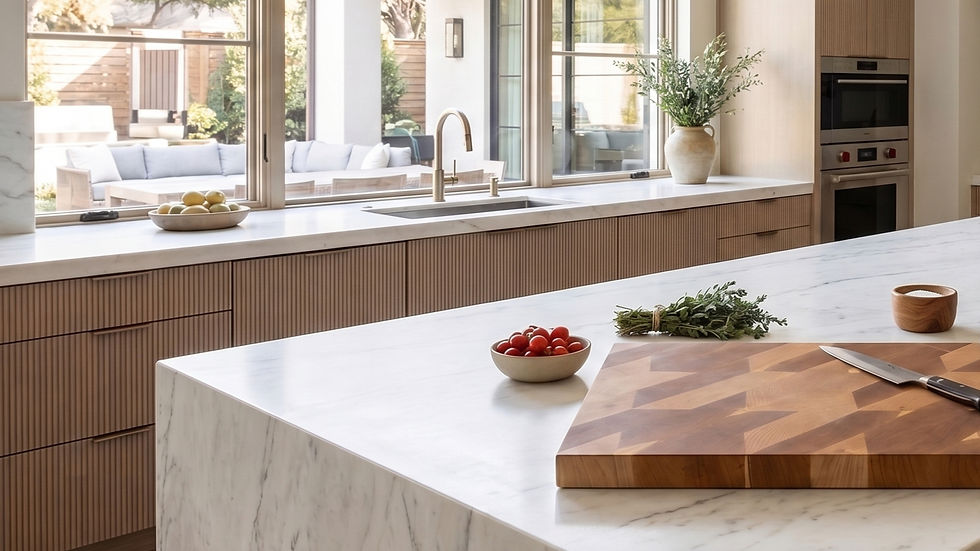
Beyond Utility: How Luxury Functional Art Cutting Boards Redefine Design-Led Luxury

The threshold where a utilitarian tool ascends to functional art is defined by a shift from temporary consumption to eternal curation, established through the creator's intent to produce a legacy, the scarcity of material provenance, and a mastery of wood’s anisotropic stability. At Key Home Goods, based in Heath, Texas, we define functional art as the intersection of wood science and heirloom craftsmanship. While kitchenware is defined by its immediate utility and eventual disposal, luxury functional art cutting boards are sculptural assets characterized by geometric parquetry and cellular integrity, designed to be protected as a generational heirloom.
The Evolution of the Kitchen: Why Luxury Functional Art Cutting Boards are Essential for Curated Spaces
In the contemporary landscape of high-end interior design, the kitchen has undergone a radical transformation from a sequestered service area to the aesthetic and social epicenter of the home. This shift has created a profound dissonance: while the architecture and cabinetry of these spaces reflect a "Design-Led Luxury" ethos, the implements within them often remain trapped in the cycle of mass-market consumption. To resolve this, the discerning collector must look beyond the category of kitchenware and recognize the emergence of functional art.
The distinction is not merely one of price or branding. It is a fundamental difference in the temporal horizon of the object. Kitchenware is an expense, a tool designed for a specific lifecycle of utility, after which it is discarded. Luxury functional art cutting boards, as epitomized by the Key Home Goods Signature Collection, is an investment in permanence. It is a sculptural object that serves a purpose while simultaneously acting as a repository for family history and a testament to the stewardship of the owner.
This transition from a consumer to a collector mindset requires an understanding of the object’s soul. Its origin, its mechanism, and its future outlook. When you acquire a Key Home Goods board, you are not simply buying a surface for food preparation. You are crossing a threshold into a realm where craftsmanship meets connection, and where every cut is a visual delight mediated by centuries-old techniques.
The Engineering of Heirloom Surfaces
One must move beyond the superficial and examine the microscopic reality of the material to understand a wooden surface as a sculptural asset. Wood is not a static substance. It is a porous, three-dimensional, hygroscopic, and viscoelastic anisotropic biopolymer composite. At Key Home Goods, the engineering of heirloom surfaces involves a rigorous application of wood science to ensure that the beauty of the parquetry is matched by its structural resilience.
Lignin and Longevity: The Science Behind Luxury Functional Art Cutting Boards
At the cellular level, the integrity of a high-end cutting board is governed by the presence and state of lignin. Lignin is a complex organic polymer that acts as the primary adhesive, binding the hollow cellulose fibers together to provide rigidity to the plant structure. In the hardwoods selected, such as American Walnut and Maple, the lignin content ranges from 18% to 25%.
The strength of lignin is so significant that wood failure typically occurs through the crushing of the cellulose structure rather than a breakdown of the lignin-rich middle lamella. This scientific reality is the foundation of the end-grain construction technique. By orienting the wood so that the knife contacts the ends of the cellulose fibers rather than their sides, we create a "self-healing" surface. The knife blade slides between the fibers, which are held in a matrix of lignin, and when the blade is removed, the fibers return to their original position, preserving the visual integrity of the sculptural form.
Anisotropic Stability and Stress Management
The greatest challenge in creating functional art from wood is its high anisotropy. The phenomenon where physical properties change depending on the direction of the grain. Wood is technically modeled as a transversely isotropic material, where the governances of stress and strain differ significantly from isotropic materials like steel or glass.
For example, the tensile strength of wood is at its lowest when force is applied perpendicular to the grain, often representing only 5% to 10% of the strength found parallel to the grain. Furthermore, the hygroscopic nature of wood, its tendency to attract and hold water molecules, leads to swelling and shrinkage as humidity fluctuates. In a mass-market board, these forces often lead to warping or "checking" (cracking).
At Key Home Goods, anisotropic stability is achieved through precise geometric parquetry. By arranging end-grain blocks in complex patterns like the signature houndstooth, the internal stresses of the wood are distributed across a multi-directional grid. This engineering minimizes the risk of dimensional changes and transforms the cutting board from a simple plank into a sophisticated piece of bio-engineering.
From Tools to Treasures: Transitioning to Luxury Functional Art Cutting Boards
The movement toward luxury functional art cutting boards represents a conscious turn away from a culture saturated with disposable goods and toward a more intentional mode of living. Mass-market kitchenware is produced in a factory setting where precision and beauty take a backseat to profit margins. These boards are often made from low-grade lumber and held together with questionable adhesives, resulting in a product that depreciates the moment it is used.
In contrast, the functional art of Key Home Goods is defined by intentionality. From the hand-selection of lumber to the meticulous book-matching of each grain, every board is treated as a one-of-one creation. This is the essence of curation: the selection of objects that reflect the owner’s aesthetic evolution and personal story.
The Collector's Mindset
Moving from a consumer mindset to a collector mindset involves recognizing that a luxury object is a catalyst for connection. It is not merely a tool for chopping vegetables. It is a centerpiece for gatherings and a canvas for creating memories. As the collector uses the board, the wood develops a patina. A visual history of the meals shared and the moments celebrated. This emotional function is what elevates the object beyond its utility.
The value of this design-led luxury is not in the wood alone, but in the hours of expert labor, the rarity of the materials, and the industry-leading white-glove service that accompanies the purchase. A collector understands that a $50 board is not saving money; it is costing them longevity, beauty, and the joy of ownership.
Production Discipline
Key Home Goods operates under a Zero-Defect Philosophy:
Handcrafted one-at-a-time in our Heath, TX studio.
Strict governance of wood's internal stresses.
Meticulous book-matching of grain patterns.
This discipline is not a marketing tactic; it is governance. It filters ownership through a curated system where only those who seek beauty, exclusivity, and purpose can acquire a piece. The dedication to our craft means that a Key Home Goods board is a rare treasure, destined to remain relevant and functional for fifty years or more.
The Heirloom as a Tangible Archive
The traditional concept of an heirloom, an artifact we inherit from the past, is evolving. Today, we have the opportunity to create the heirlooms of the future. A Key Home Goods board is a tangible archive of joy and togetherness, a vessel for memories that will gather meaning with every passing year. By choosing an object built from tradition and designed for permanence, the owner is making a statement about their values: they value the enduring over the transient, the hand-made over the machine-made, and the story over the transaction.
Geometric Parquetry: The Intersection of Art and Engineering
The hallmark of the Signature Collection is the use of geometric parquetry. A technique historically reserved for the floors of European palaces and the surfaces of fine furniture. Parquetry involves the arrangement of repeating shapes, diamonds, triangles, and squares, to create striking visual effects, such as the iconic houndstooth pattern.
The Precision of the "Pattern within a Pattern"
At Key Home Goods, this technique is taken a step further through book-matching the wood's grain within the geometric segments. This creates a layered, dimensional effect where the grain itself follows the pattern, a feat that requires absolute accuracy. Even a fraction of a millimeter of misalignment in the cuts can disrupt the entire composition.
To achieve this level of detail, the craftsman must manage several variables:
Tonal Balance: Using contrasting hardwoods like Maple (light), Cherry (mid-tone), and Walnut (dark) to create depth and highlight the optical illusion.
Fiber Stabilization: Before the final assembly, the wood segments must be stabilized to prevent splintering and ensure clean, precise edges. A process that involves multiple passes and constant monitoring of the wood's internal stresses.
End-Grain Integrity: Unlike furniture parquetry which often uses thin veneers, Key Home Goods utilizes thick end-grain blocks, which provide a professional-grade cutting surface while maintaining the visual complexity of the art piece.
This synthesis of historical craftsmanship and modern engineering results in a custom composition that is a rarity in the world of kitchen tools.
The Threshold of Excellence
The following table provides a definitive comparison between mass-market kitchenware and the functional art of the Key Home Goods Signature Collection. This data illustrates why the latter should be viewed as an appreciating asset rather than a depreciating tool.
Attribute | Mass-Market Kitchenware | Key Home Goods Functional Art |
Primary Intent | Immediate Utility and High Volume | Legacy Stewardship and Cultural Curation |
Material Grade | Standard Hardwood or Synthetic Blends | Hand-selected, Premium Hardwoods (Top 3% figure rarity) |
Design Philosophy | Basic Ergonomics and Cost Efficiency | Sculptural Form and Narrative-Led Design |
Construction | Edge-grain or Face-grain (Disposable) | Meticulous End-grain Parquetry (Self-healing) |
Production Model | Mass-produced in overseas factories | Handcrafted, one-at-a-time in Heath, TX |
Value Retention | Depreciating Tool; eventually discarded | Appreciating Asset; Generational Heirloom |
Service Model | Transactional and Impersonal | Concierge-style, White-Glove Service |
Durability Basis | Synthetic Adhesives and Low-Grade Fibers | Lignin Integrity and Anisotropic Stability |
Case Studies in Functional Art
The Statement: A Declaration of Style
The Statement is not merely a name. It is an expression of skilled artisanship and bold proportions. Featuring an oversized houndstooth pattern, this board is designed to be the centerpiece of a high-end kitchen. The end-grain construction is gentle on the finest knives, while the striking visual geometry demands attention as a work of art. It represents the perfect synthesis of heritage craftsmanship and timeless functionality, backed by our Timeless Guarantee that covers craftsmanship and materials for life.

The Live Board: Organic Minimalist Luxury
For those who value a connection to nature, The Live Board offers organic elegance. Crafted from premium-grade Curly Maple, a material so rare it is typically reserved for fine musical instruments, the board features luminous rippling and visual depth that shifts with the light. By pairing the untamed edge of the tree with clean book-matched symmetry, we create an understated, sculptural presence that celebrates the raw beauty of the natural world.

The Choice of the Discerning Collector
Crossing the threshold from kitchenware to functional art is an invitation to savor life’s richest moments. It is the pride of owning a piece of art that enhances the home, the joy of sharing meals on a surface as unique as one’s own story, and the comfort of knowing that the object is supported by an unwavering dedication to excellence.
When we choose functional art, we reject the impersonal nature of mass production and embrace the soul of handcrafted objects. We become the guardians of a tradition that honors the past while shaping the future. A Key Home Goods board is more than a tool. It is a storyteller in its own right, a vessel for memories waiting to be made, and a cornerstone of the modern legacy kitchen. In the end, elegance is more than a price, it is a feeling. The feeling of a life well-lived and a home well-curated.
Explore our collection, and begin writing the next chapter of your story today. Cheers!
Frequently Asked Questions
Question | Answer |
What is the difference between kitchenware and functional art? | Kitchenware is defined by immediate utility and eventual disposal, whereas functional art is a sculptural asset designed as a generational heirloom. |
Why are end-grain cutting boards better for knives? | End-grain construction allows the knife to slide between wood fibers held in a lignin matrix, creating a "self-healing" surface that preserves the board's integrity. |
What makes a Key Home Goods board a sculptural asset? | Every board utilizes geometric parquetry and wood science, specifically managing anisotropic stability, to ensure structural resilience and visual beauty. |
How long does a luxury functional art cutting board last? | With proper stewardship and a Zero-Defect production philosophy, these boards are designed to remain functional and relevant for fifty years or more. |
What wood is used in high-end functional art? | Key Home Goods selects premium hardwoods like American Walnut, Hard Maple, Cherry, and rare Curly Maple, often featuring top 3% figure rarity. |
About the Author
The authority of Key Home Goods is personified in its Founder and Master Craftsman, Andrew Key. With six years of specialized experience in designing and making high-end cutting boards, Key has dedicated his career to "bringing beauty back to utility.” Based in Heath, Texas, his studio is a place where tradition, innovation, precision, and artistry are blended into every creation.
The Zero-Defect Philosophy ensures that every board is a rare treasure, reserved for those who seek beauty and purpose in every object they own. His commitment to legacy craftsmanship means that his boards are built not just for today, but for generations of families yet to come. He views his work not merely as manufacturing, but as a reverence for creation and connection, where every piece becomes a cherished heirloom.