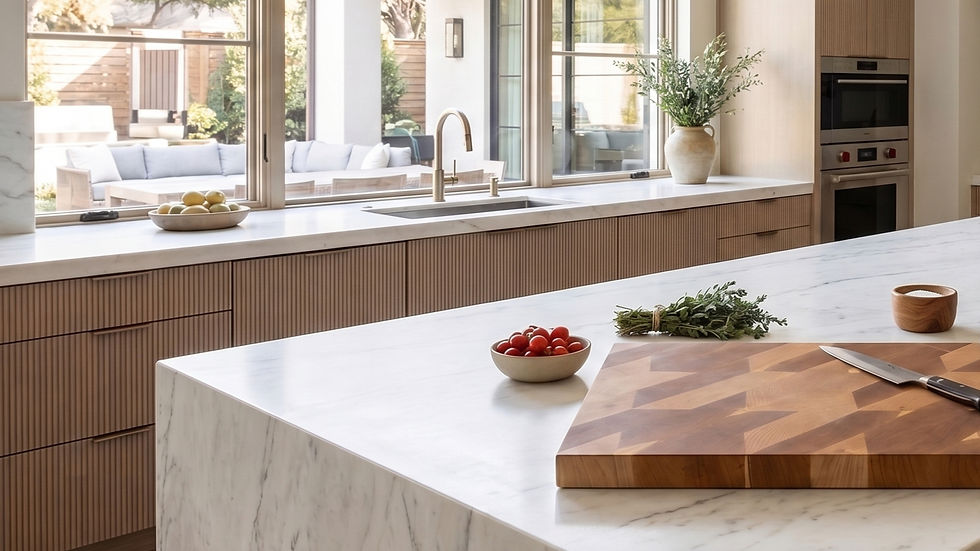
The Luxury End-Grain Butcher Block: From Paris Markets to Preston Road Estates

The transition of the heavy-duty wood butcher block from the industrial meat markets of nineteenth-century Paris to the elite residential estates of Dallas represents a profound evolution in both culinary history and material design. By merging the principles of wood anisotropy with the aesthetic codes of quiet luxury, the modern end-grain block has shifted from a utilitarian trade tool into a prized piece of functional art. This evolution highlights a growing appreciation for architectural heritage, molecular wood science, and generational stewardship within the modern high-end home.
An heirloom-grade butcher block is distinguished from standard kitchenware by its end-grain construction, material density, and structural engineering designed for generational longevity. While standard retail boards utilize face-grain or edge-grain layouts that sever under blade contact, an heirloom block aligns wood fibers vertically, parallel to the direction of tree growth, enabling a self-healing mechanism where the blade slides between fibers rather than cutting them. Engineered from premium, close-grained hardwoods like Hard Maple (Acer saccharum) with a high Janka hardness of 1,450 lbf, these masterfully constructed blocks leverage alternating grain orientations to neutralize wood anisotropy and prevent warping from humidity shifts. Bonded with food-safe, high-tensile adhesives and sealed with hydrophobic natural waxes, they offer superior sanitary performance and knife-edge preservation that mass-produced alternatives cannot replicate.
From Les Halles to High-End Estates: The Industrial Origins of the Luxury End-Grain Butcher Block
The culinary history of the modern heavy-duty butcher block is deeply rooted in the industrial, highly demanding meat markets of nineteenth-century Paris. For centuries, Paris's central food market, Les Halles, originally founded in 1110 by Louis VI, nicknamed "Louis the Fat" due to his imposing physical stature, served as the high-volume culinary epicenter of France. In 1183, King Philip Augustus took full control of this open-air market, then known as Les Champeaux ("The Little Fields"), constructing permanent stone walls and building two covered market halls specifically designed to protect textile and wool vendors.
By the early fifteenth century, the market had expanded dramatically into foodstuffs, prompting a royal mandate that legally obliged Parisian butchers to operate within a centralized, dedicated hall. This massive concentration of culinary trade eventually culminated in the mid-nineteenth century with the construction of Victor Baltard’s famed covered pavilions. These twelve avant-garde structures of cast iron and glass represented a monument of modern design, famously immortalized by novelist Emile Zola in 1873 as "Le Ventre de Paris" ("The Belly of Paris"). Within these pavilions, thousands of tons of meat were traded, butchered, and sold under the glow of gaslights in the middle of the night.
To withstand the relentless, high-impact force of massive iron cleavers and carving knives, commercial butchers initially relied on solid, single-piece tree rounds. However, these primitive rounds presented severe functional and sanitary limitations: they cracked along their radial planes, wore down unevenly, and harbored organic debris in their soft, degrading surfaces. The mid-nineteenth century invention of the circular saw revolutionized industrial woodworking, enabling the production of clean, laminated hardwood slabs.
This technical breakthrough led to the development of the commercial end-grain butcher block. These massive standalone blocks, which measured up to 31 inches square and reached thicknesses between 5 and 30 inches, often weighed up to 400 pounds. Supported by four robust wooden legs, these colossal work surfaces accommodated up to four butchers working simultaneously on a single carcass.
At a cellular level, the physics of end-grain construction are remarkably elegant. Wood is a highly anisotropic, fibrous material, resembling a dense bundle of parallel capillary tubes aligned with the tree's vertical growth axis. When a butcher's cleaver strikes an end-grain surface, the blade does not sever the cellulose fibers; instead, it penetrates between them, parting the vertical cell walls. When the blade is withdrawn, the surrounding fibers compress and slide back into place, driven by natural lateral pressures and the elastomeric properties of the wood matrix. This "self-healing" physical property dramatically reduces surface damage and preserves the structural integrity of both the cutting surface and the artisan cutlery.
Traditional Codes and the European Estate
During the late nineteenth and early twentieth centuries, the end-grain butcher block underwent a significant cultural translation, transitioning from the raw, commercial atmosphere of Les Halles into the highly ordered, classical kitchens of European estates. The formalization of classic haute cuisine, championed by master chefs who demanded precision, hygiene, and durability, necessitated a parallel evolution in prep-space architecture.
In grand country houses and urban chateaux, the culinary workspace was reimagined as a disciplined, highly organized system. The heavy-duty end-grain block emerged as a central pillar of this environment. It was no longer a mere trade tool, but a permanent architectural statement of abundance and culinary mastery. This shift reflected a growing appreciation for material permanence and master craftsmanship, establishing traditional codes that linked raw woodware to elite social status.
The biological composition of close-grained hardwoods like Hard Maple (Acer saccharum) played a critical role in this domestic integration. Within the secondary cell walls of Acer saccharum, cellulose microfibrils are embedded in a complex, rigid matrix of hemicellulose and lignin, providing an exceptional parallel-to-grain crushing strength and a high modulus of elasticity. This molecular density, combined with the wood's natural antibacterial qualities, provided a self-cleansing surface that met the rigorous hygienic demands of noble estates long before the advent of synthetic materials.
The Preston Road Evolution: From Tool to Functional Art
Today, this rich heritage has culminated in a modern design renaissance, particularly within the elite residential enclaves of Dallas, Texas. Along the prestigious corridor of Preston Road and the private estates of Highland Park and Preston Hollow, the modern kitchen is characterized by biophilic design, minimalist architecture, and a deep appreciation for generational stewardship. In these meticulously curated spaces, which often mirror the clean, light-filled geometry of architectural landmarks like the Richard Meier-designed Rachofsky House, the kitchen island has evolved into a monumental trophy Island.
The trophy island serves as the visual and functional anchor of the modern high-end home, demanding materials that balance organic warmth with architectural permanence. The heavy-duty, heirloom-tier end-grain block has ascended to become the defining element of this centerpiece. Shifting completely from a utilitarian accessory to a monumental piece of functional art. Placing a massive, custom-built Hard Maple end-grain block atop natural stone countertops creates an intentional, biophilic tension between the cool precision of quartz or marble and the rich, tactile history of natural wood.
The Physics of Acer Saccharum: Engineering the Ultimate Luxury End-Grain Butcher Block
Crafting a block capable of serving as a permanent architectural fixture requires a sophisticated understanding of material physics, specifically wood anisotropy. Wood is dimensionally dynamic; it swells and shrinks unequally along its radial, tangential, and longitudinal axes in response to humidity shifts. Hard Maple (Acer saccharum) is particularly challenging, exhibiting a radial shrinkage of 4.8% and a tangential shrinkage of 9.9%, resulting in a highly volatile Tangential-to-Radial shrinkage ratio.
In the variable climate of North Texas, where hot, humid summers transition to dry, air-conditioned winters, a standard retail cutting board will rapidly cup, warp, or split. Master craftsmen counteract this inherent material instability through rigorous engineering protocols. At the Key Home Goods studio in Heath, Texas, raw lumber is hand-selected based on age, cellular density, and growth ring orientation. The wood segments are then meticulously arranged using an alternating grain orientation. This deliberate technique pits opposing expansion forces against one another, neutralizing dimensional movement and ensuring the block maintains its flat, stable form over a lifetime of use.
Biophilic Luxury: Elevating the Trophy Island with a Custom Luxury End-Grain Butcher Block
The structural and aesthetic apex of this engineering is the signature book-matched houndstooth pattern developed by Key Home Goods. Each block segment is cut at precise angles and paired with its optical twin to enhance the natural, flowing symmetry of the end-grain fibers. This intricate pattern is not merely decorative; it represents a commitment to material mastery where every joint serves a structural purpose.
To ensure maximum durability, the rows are bonded using Titebond III, an advanced, EPA-approved, food-safe adhesive that provides high-tensile strength and complete water resistance. The surface is then meticulously sanded to a velvet finish and treated with a deep saturation of food-grade mineral oil, followed by a protective sealant composed of mineral oil and Texas-sourced beeswax. This final treatment forms a naturally hydrophobic shield, locking out excess moisture while preserving the organic breathability of the wood. The result is a sculptural masterpiece that bridges the gap between scientific precision and luxury.
Cultivating a Culinary Legacy: The Ultimate Value of a Luxury End-Grain Butcher Block
Ultimately, the transition of the heavy-duty cutting surface from the historic pavilions of Paris to the grandest residential estates of Dallas proves that true utility is timeless. A custom, heirloom luxury end-grain butcher block is far more than a culinary accessory; it is a monumental piece of functional art engineered to withstand both the physics of impact and the fluctuations of time. By blending the rigorous molecular science of Hard Maple (Acer saccharum) with sophisticated design elements like the signature book-matched houndstooth pattern, Key Home Goods honors the noble tradition of generational stewardship.
For the modern trophy island, investing in such masterful craftsmanship is not merely an aesthetic choice. It is an investment in a lasting culinary legacy meant to be passed down through a new dynasty of family history.
Frequently Asked Questions
Question | Scientific/Historical Reality | The Luxury Standard |
What is the hygienic reality of end-grain hardwood compared to modern synthetic surfaces? | Research conducted by Dr. Dean Cliver and Charles W. Kaspar at the University of Wisconsin-Madison and later UC Davis revealed that wood's porous cellular structure acts via capillary action to draw bacteria (including Salmonella, Escherichia coli O157:H7, Campylobacter jejuni, Listeria monocytogenes, and Staphylococcus aureus) deep into the interior fibers. Once trapped inside the close-grained wood matrix, these pathogens are unable to multiply and gradually die. Conversely, synthetic plastic cutting boards develop deep micro-scars and incisions over time from standard knife impacts. These non-permeable scars trap organic matter, chicken fats, and moisture, creating a highly sheltered harbor for bacterial colonies that resists manual manual cleaning with hot water and dish soaps. Epidemiological data confirmed that households using wooden cutting boards were more than fifty percent less likely to contract salmonellosis, whereas synthetic board users had an elevated risk factor nearly double the baseline average. | Cultivating a pristine culinary environment requires avoiding microplastics and toxic chemical sanitizers. Utilizing a massive, self-sanitizing hardwood surface represents the pinnacle of ecological luxury and biome safety. |
Why is end-grain construction considered mandatory for preserving bespoke culinary knives? | End-grain surfaces position the wood fibers vertically, parallel to the direction of tree growth, resembling a bundle of vertical straws. When a blade impacts an end-grain surface, the edge slips between these vertical cell structures rather than severing them. Upon retracting the knife, the elastomeric recovery of the surrounding cell walls closes the temporary gap, representing a natural self-healing phenomenon. In edge-grain or face-grain cutting boards, the wood fibers are oriented perpendicular to the knife edge, forcing the blade to shear across the rigid cellulose walls. This high-friction contact rapidly rolls and dulls the delicate edge of custom-forged steel. | Preserving custom-forged, high-hardness culinary knives (such as bespoke Damascus or Japanese Aogami steel) demands a surface that yields to the edge. An end-grain canvas ensures edge geometry remains pristine for extended periods. |
What structural parameters separate standard retail butcher blocks from heirloom-tier blocks? | Mass-produced retail cutting boards are typically constructed using uniform grain alignments, low-density timbers, and cheap adhesives, making them highly susceptible to cupping, splitting, and warping due to wood's inherent anisotropy. Hard Maple (Acer saccharum) exhibits a high Janka hardness (1,450 lbf) and a Tangential-to-Radial shrinkage ratio of 1.9. Heirloom blocks counteract this dimensional instability by utilizing alternating grain orientations, hand-selection based on density and growth rings, and a signature book-matched houndstooth alignment bound with premium, water-resistant Titebond III adhesive. | The signature book-matched houndstooth pattern is a structural and aesthetic triumph, turning a heavy-duty preparation block into a generational legacy piece that withstands the environmental fluctuations of the grandest estates. |
About the Author
The crafting of these generational masterpieces is overseen by Andrew Key, Founder and Craftsman of Key Home Goods based in Heath, Texas. With seven years of hyper-specialized experience working exclusively with elite North American hardwoods, specifically American Black Cherry and Hard Maple, Andrew Key operates at the intersection of material science, classical design, and physical craft.
Viewing wood not merely as a raw material but as a living medium requiring careful stewardship, the craftsman ensures that every block produced is a custom, book-matched composition engineered to withstand the test of time. This devotion to preservation extends from the molecular stabilization of the timber to Key Home Good's tree-to-table sustainability commitment, which actively restores the natural forests that inspire each architectural creation.