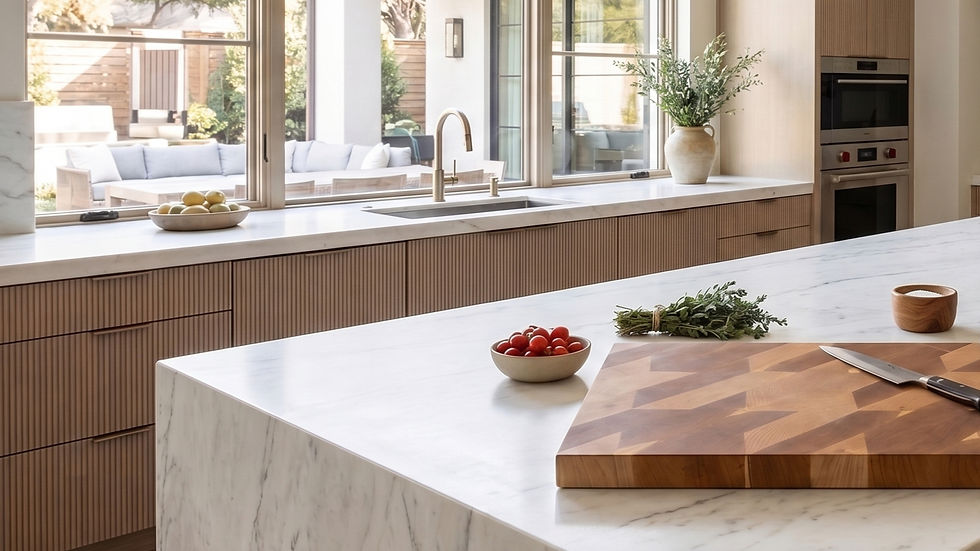
How Bespoke Wood Pieces are Redefining the Modern Kitchen
Updated: Jul 16, 2025

The Soul of the Modern Kitchen
The modern kitchen has undergone a profound transformation. Once a purely utilitarian zone, segregated and sterile, it has now firmly established itself as the home's emotional and social nucleus. This evolution from a functional workspace to a central living area has catalyzed a significant shift in design philosophy. Homeowners and designers are increasingly moving beyond neutral-toned, purely functional layouts to embrace kitchen interiors that are warm, soothing, and expressive. This paradigm shift has created a powerful demand for materials and objects that infuse the space with texture, character, and an intrinsic connection to the natural world. The humble wood cutting board, long relegated to the cabinet, has been elevated to meet this demand, emerging as a pivotal accessory in defining the soul of the new kitchen.
This trend is not a fleeting aesthetic preference but is deeply rooted in the principles of biophilic design, a discipline centered on creating a stronger connection between indoor environments and the natural world. Biophilic design posits that incorporating natural elements like wood, stone, greenery, and abundant natural light into our living spaces creates a calming, grounded environment that enhances well-being. Wood accessories, in particular, are valued for their ability to infuse interiors with organic texture, warmth, and character, making spaces feel more inviting and serene. Wood cutting and charcuterie boards serve as a perfect micro-application of this macro trend. They are accessible, functional objects that introduce the tactile qualities of wood that studies have shown can be soothing and grounding.
The durability of this trend is further substantiated by design forecasts for 2025 and 2026, which consistently point to the continued dominance of warm neutrals layered with light natural wood tones, the prioritization of sustainable materials, and a preference for lived-in, layered spaces. As kitchens become more seamlessly integrated with adjacent living areas, the need for aesthetic continuity and warmth becomes paramount. The popularity of the wood board is not an isolated fad; it is a direct symptom of this larger, more enduring shift in design philosophy toward authenticity and a connection with nature. This connection to fundamental human well-being, rather than just passing styles, secures the trend's longevity. For the design professional, this indicates that specifying high-quality, character-rich wood boards is not merely following a trend, but is a sound strategy for creating timeless, emotionally resonant spaces that meet a deep-seated client need.
From Utility to Ubiquity: The Cutting Board as a Design Essential
The wood cutting board's journey from a concealed kitchen tool to a ubiquitous element of interior styling marks a fundamental shift in the object's perceived role. No longer just a surface for chopping, it has become a piece of functional art. A versatile accessory used by designers and homeowners to add layers of warmth, color, and texture to the kitchen environment. This transition is not accidental but is driven by specific, repeatable styling techniques that address contemporary design needs.
Styling Techniques and Their Aesthetic Purpose
The most prevalent application is countertop layering. This technique involves propping one or more boards against the backsplash, often in curated groups of varying sizes, shapes, and wood tones. The primary aesthetic purpose is to introduce a natural, organic element that provides a warm contrast to the cool, hard surfaces of stone or quartz countertops. This layering breaks up monolithic surfaces, creates visual depth, and can effectively warm up the aesthetic of an all-white kitchen, preventing it from feeling sterile.
A second key technique is displaying boards as wall art. Boards are hung on kitchen walls, either individually or as a thoughtfully arranged collection. This can be achieved with simple materials like twine or leather straps for a rustic feel, or with more structured rod-and-hook systems for a polished look. This method explicitly treats the board as a decorative object, utilizing its shape and the unique grain of the wood to fill blank wall space and contribute to a modern farmhouse, bohemian, or collected aesthetic.
Finally, strategic placement allows the board to serve as a functional backdrop or anchor. Placed behind a stovetop, a large board can protect a porous backsplash from grease splatters while simultaneously adding a pop of warmth and texture to an often-underutilized space. When used on a kitchen island, a board can act as a tray or base for a decorative vignette, grounding other items like a vase of flowers, a candle, or a bowl of fruit and creating a clear focal point in the center of the room. The explosive popularity of charcuterie, largely fueled by visually-driven social media platforms, has also significantly amplified the board's importance. An aesthetically pleasing board is now a prerequisite for modern entertaining, ensuring it must be display-worthy even when not in use.
The Decorative Response to Minimalist Architecture
The elevation of the cutting board to a design essential is directly linked to the evolution of kitchen architecture itself. As kitchen design trends for 2025 and 2026 move toward more streamlined and integrated layouts with fewer upper cabinets, concealed appliances, and clean, uncluttered surfaces, the walls and countertops become the primary canvases for expressing personality and style. This minimalist architecture creates a design challenge: how to introduce the desired lived-in, layered feel without resorting to simple clutter.
The cutting board resolves this tension perfectly. Because its primary identity is that of a functional tool. Its presence on the counter or wall is inherently justified. It does not register as superfluous decoration in the same way a purely ornamental object might. This allows it to add the necessary layers of texture, color, and natural warmth without compromising the clean, minimalist foundation of the space. In essence, the trend of minimalist kitchen architecture creates the stage, and the decorative wood board has become one of the star performers. For a designer, this means that in any kitchen featuring open shelving, significant counter space, or minimal upper cabinetry, a curated collection of wood boards is not just a styling option; it is a strategic tool for achieving the layered, warm, and authentic aesthetic that contemporary clients demand.
The Anatomy of Distinction: Deconstructing the Elevated Board
While the trend has made wood boards a common sight, a significant gap in quality, character, and design intent separates a mass-market product from an elevated, artisanal board. For the discerning designer, understanding this distinction is crucial for specifying pieces that not only complement a high-end design but enhance it. The value of an elevated board is found in its material integrity, artistry of the craftsman, and its architectural presence.
Material Integrity: The Foundation of Quality
The soul of a superior board lies in its wood. Premium North American hardwoods like maple, walnut, and cherry are consistently cited as the materials of choice for their durability, rich aesthetic, and kindness to knife edges. Darker woods such as walnut are particularly prized for their ability to camouflage knife marks over time. Beyond the species, the construction method is a key differentiator.
End-grain construction, where blocks of wood are fused with the grain oriented vertically, is the undisputed gold standard. Prized by professional chefs, this surface is self-healing, as knife blades slide between the wood fibers rather than cutting across them. Preserving both the knife and the board.
True distinction, however, often comes from woods that carry an intrinsic story. Live edge boards, which retain the natural, uncut edge of the tree, are a defining trend for 2025. Each one is inherently one-of-a-kind, offering an organic, rustic elegance that cannot be replicated. This style brings the untamed spirit of the tree directly into the kitchen. Similarly, reclaimed wood sourced from historic structures like 19th-century barns or cotton mills offers a piece of history. This old-growth wood is often denser and more stable than new lumber. Its perfectly imperfect character, replete with nail holes, saw marks, and a rich patina, is a desirable feature instead of a flaw.
The Mark of the Artisan: Craftsmanship and Design Intelligence
The growing appreciation for handmade excellence is a direct counter-response to the ubiquity of mass production. An artisanal board is defined by the care, attention to detail, and design intelligence invested by its maker. This is evident in the quality of the finish, the precision of the joinery, and the creativity of the design. Artisans often experiment with unique forms, patterns, and wood species to create statement pieces that transcend pure function. This handcrafted approach ensures not only superior quality but a level of authenticity and uniqueness that machine production cannot match.
Architectural Presence: Sculptural and Substantial Design
An elevated board possesses a physical presence that commands attention. This is often achieved through significant thickness and weight. High-end boards are frequently 1.5 to 4 inches thick or more, giving them a substantial, butcher-block feel that provides stability during use and a commanding presence on the counter. A key feature that literally elevates a board is the inclusion of risers or feet. These small pedestals lift the board off the countertop, creating shadow lines, allowing for proper air circulation and drying, and giving the piece the distinguished presence of a small piece of furniture. Finally, thoughtful functional details like well-executed juice grooves to corral liquids for instance, are the hallmarks of a board designed with both beauty and utility in mind.
The following table provides a clear framework for differentiating between a standard board and its elevated, artisanal counterpart, justifying the investment in quality for a high-end design project.
Feature | Standard Mass-Market Board | Elevated / Artisanal Board |
Material | Often made of softer woods, bamboo, or even plastic; appearance is uniform and lacks unique character. | Crafted from premium hardwoods like maple and walnut, or unique story-woods such as live edge and reclaimed timber. |
Construction | Typically edge-grain or face-grain construction; may be glued from thin, unremarkable strips of wood. | Features superior end-grain construction; can be made from a single solid slab; joints are handcrafted with precision. |
Design | Basic rectangular shapes; thin profile (often less than 1 inch); frequently lacks functional features like juice grooves. | Exhibits sculptural forms, mixed accents, substantial thickness (1.5"+), and architectural details like feet/risers. |
Origin & Story | Mass-produced in an anonymous factory setting; origin is untraceable and lacks a narrative. | Handcrafted by a named artisan or small business; material source is often traceable; possesses an inherent story (e.g., reclaimed history, unique tree). |
Aesthetic Impact | Functions primarily as a utilitarian kitchen accessory with limited to no decorative value. | Serves as a piece of functional art; a statement piece that acts as a focal point and a conversation starter. |
The Sourcing Dilemma: An Interior Designer's Quest for Authenticity
For the professional interior designer, creating a unique and deeply personal space for a client is the ultimate goal. However, the process of realizing this vision is fraught with practical challenges, particularly in the realm of sourcing and procurement. The quest for unique, high-quality accessories is a significant undertaking that consumes an inordinate amount of time, financial resources, and creative energy, representing a major pain point in the design process.
The Complexities of the Sourcing Process
Interior design sourcing is a multifaceted discipline that extends far beyond simple shopping. It involves a rigorous process of researching, identifying, negotiating prices for, and managing the logistics of every single item. From furniture and fixtures to the smallest decorative accessories. Designers have to ensure they align perfectly with the design concept, client budget, and project timeline. Designers are constantly on the hunt for one-of-a-kind pieces that will set their projects apart from generic, mass-produced interiors and infuse the space with the client's unique personality. This often necessitates countless hours spent scouring antique shops, sifting through vintage markets, and attempting to discover local artisans who can provide that unique touch.
The Inefficiency of Overbuying
The inherent difficulty in finding the perfect piece on demand has led to a common but highly inefficient industry practice: overbuying. To mitigate the risk of an item not working in the space or failing to find the right object at the right time, designers will intentionally purchase a wide array of accessories. Far more than are actually needed. They then bring this large inventory to the client's home, style the space using the various options, and finally, undertake the laborious process of returning the unused items.
This strategy, while born of necessity, is a clear symptom of a fundamental market inefficiency. There is a significant disconnect between the designer's need for a specific, unique, and perfectly scaled item and the ability of the retail and vintage markets to provide it reliably. This sourcing dilemma represents a direct and substantial cost to the designer, not only in the billable hours spent shopping and returning goods, but also in the capital temporarily tied up in merchandise and the logistical burden of managing it all. It is an economic problem as much as it is a creative one, highlighting a clear gap in the market for a more streamlined, reliable method of acquiring perfectly matched, unique items without the need for speculative purchasing. This is precisely the gap that a partnership with a bespoke artisan is positioned to fill.
Beyond this inefficiency, designers face a host of other sourcing challenges. They must navigate tight budget constraints while meeting sky-high client expectations, manage the unpredictability of global supply chains and rising material costs, and invest the time to find and build relationships with reliable, skilled craftspeople who can deliver quality work on schedule.
The Collaborative Advantage: Crafting Cohesive Narratives with Bespoke Artistry
The sourcing dilemma, with its inherent inefficiencies and creative frustrations, finds its most elegant solution in a strategic partnership between the interior designer and the bespoke artisan. This collaboration transcends a simple transaction, reframing the acquisition of a unique object as a shared creative process. For the designer, this partnership offers a direct and superior solution to the challenges of sourcing, providing unparalleled control over the final product and elevating their own value proposition to the client. The advantages can be understood through three pillars: cohesion, narrative, and efficiency.
Benefit 1: Achieving True Cohesion Through Customization
The single greatest advantage of working directly with a wood artisan is the power of customization. While sourcing off-the-shelf, a designer is limited to what already exists, hoping to find a piece that approximates their vision. In a collaborative model, the designer can commission a piece to their exact specifications. This means selecting the precise wood species, tone, and finish to perfectly match or complement the kitchen's cabinetry, the wood flooring, or even a piece of furniture in an adjacent, open-plan living space. Imagine commissioning a charcuterie board from the same species of walnut used for the dining table or specifying a finish that picks up the exact hue of the cabinet hardware. This creates a level of design harmony and visual continuity that is simply impossible to achieve through retail or vintage sourcing. Resulting in a truly cohesive and professionally resolved space.
Benefit 2: Delivering a Unique Client Story Through Narrative
In the luxury market, storytelling is paramount. Handcrafted items carry an intrinsic narrative. A soul that mass-produced objects inherently lack. A bespoke wood board comes with a rich story about its creation: the artisan who crafted it, the traditional techniques employed, and the origin of the material itself. A board made from reclaimed wood from a local historic barn, for example, is not just a beautiful object; it is a tangible piece of local history and a powerful conversation starter.
By presenting a client with a piece made specifically for their home, the designer provides an object with an emotional connection and a unique provenance. This act transforms the designer's role from that of a decorator or procurer of objects into that of a curator and a commissioner of art. It is a powerful differentiator that demonstrates a profound commitment to custom, detailed, and thoughtful design. The board becomes a tangible symbol of this elevated service, justifying higher design fees and building a reputation for providing truly bespoke interiors.
Benefit 3: A Streamlined, Expert Partnership for Efficiency
Collaborating with a trusted artisan directly addresses the inefficiencies of the traditional sourcing model. It eliminates the need for endless, speculative searching and the wasteful practice of overbuying. Instead of spending days hunting for an item that might work, the designer engages in a focused, creative dialogue to bring a specific vision to life. This saves invaluable time and resources, allowing the designer to focus on other critical aspects of the project.
Furthermore, this relationship builds a designer's network of trusted, expert suppliers. A key asset for any successful design firm. This partnership is mutually beneficial: the designer receives a unique, high-quality product that delights their client, while the artisan's small business is supported and promoted. This can lead to valuable cross-promotional opportunities, where the artisan showcases the designer's work featuring their piece, expanding the reach and reputation of both parties. This transforms the sourcing process from a frustrating challenge into a strategic, efficient, and creatively fulfilling partnership.
The Lasting Impression of Handcrafted Character
The aesthetic trajectory of the modern kitchen is clear. The movement toward spaces that are authentic, layered, and deeply connected to the natural world is not a transient style but a lasting shift in our collective approach to the home's most vital room. Within this new paradigm, wood cutting and charcuterie boards have cemented their role as a key piece of functional art. An essential tool for layering in the warmth, texture, and organic character that today's designs demand.
As this analysis has shown, the most impactful and desirable of these pieces are not the uniform products of mass production, but those that possess a distinct character, a compelling story, and the unmistakable quality of artisanal craftsmanship. These are the boards that elevate a kitchen from merely well-designed to truly memorable.
For the interior design professional, navigating the path to find such unique items presents a significant challenge. However, the solution lies not in more exhaustive searching, but in a more strategic approach: direct collaboration with the artisans who create these pieces. This partnership transforms the arduous task of sourcing into a streamlined, creative process. It empowers the designer to move beyond simply finding objects to actively commissioning art, ensuring perfect cohesion with their design vision and delivering a powerful personal narrative to their client.
Ultimately, embracing bespoke artistry is more than a sourcing tactic. It is a creative strategy. It is about infusing spaces with a soul and a character that cannot be ordered from a catalog. Creating a more unique and valuable final product for the client and a more fulfilling, efficient, and distinguished process for the designer. By exploring the possibilities of custom work, designers can not only meet the demands of current trends but can also craft the timeless, resonant spaces of the future.
If you've been searching for rare and bespoke designs for your projects, shoot us an email at support@keyhomegoods.com to find out how we make dreams reality.